Planning performance index
Tasked with ensuring a five-year land supply, having a local plan in place and meeting the Housing Delivery Test, many local authorities are struggling to hit their targets

Tasked with ensuring a five-year land supply, having a local plan in place and meeting the Housing Delivery Test, many local authorities are struggling to hit their targets
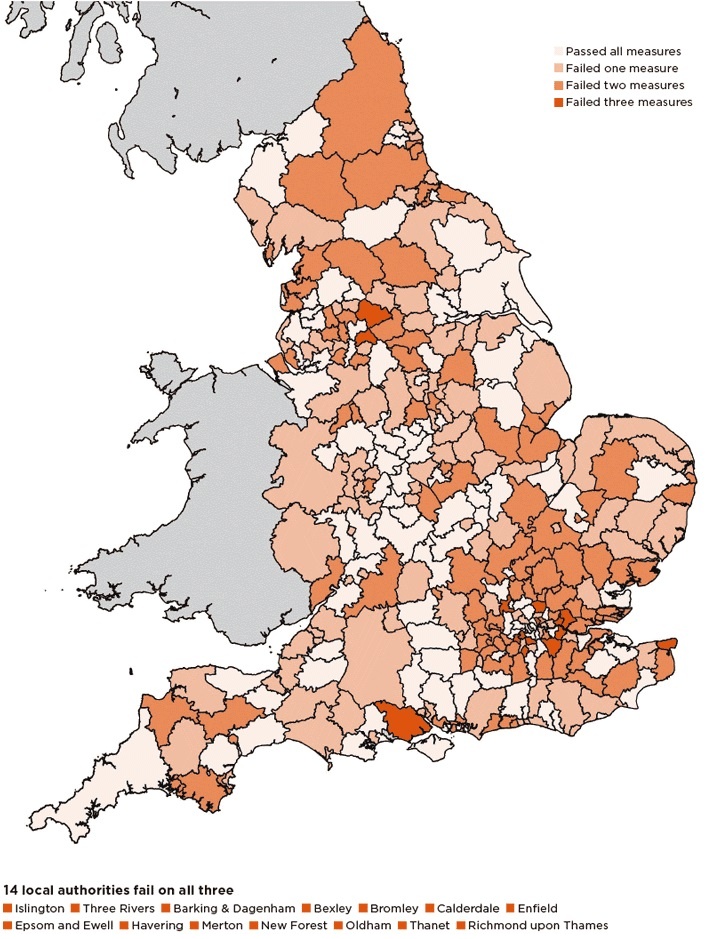
FIGURE 8 | Trouble comes in threes | Who is failing on local plan status, five year supply and the Housing Delivery Test?
Source: Savills Research
With the addition in the revised NPPF of the Housing Delivery Test, local authorities now face a three-pronged battle to hit their targets for bringing housing development forward. By combining information on five year land supply, local plan status and our projected Housing Delivery Test for 2019, we have created the Savills Planning Performance Index.
The areas that are shown as darkest orange on the map are those local authorities projected to fail on all three of these fronts: having no plan in place, fewer than five years land supply (see the map, below) and being projected to fall below the 45% target for delivery through the Housing Delivery Test in 2019.
The London boroughs of Havering and Barking & Dagenham are just two of 14 local authorities that fail on all three of the key metrics. These key growth areas in the east of the capital have seen their housing targets increase by more than 60% in the New Draft London Plan.
No room for manoeuvre
The regions surrounding London aren’t well positioned to take on the capital’s overspill either, given that many local authorities in East and South East England are unable to meet at least two of the criteria. A similar picture is emerging in Greater Manchester.
If this pattern continues, local authorities in these areas are at risk of having their local plan policies sidelined. Failing the Housing Delivery Test or being unable to guarantee a five year supply of land increases the likelihood of speculative applications for housing succeeding.
We project that 110 local authorities will fail on two or more measures by 2019. These local authorities account for 37% of national housing need and risk losing control of where housing development will take place.

FIGURE 9 | Five-year land supply
Source: Savills Research | Please see below for the methodology used to create the data above
Five-year land supply
Identifying enough land to achieve the required level of housing delivery remains a challenge for many local authorities. In the year to April 2018, 61 local authorities (19%) had a lack of five-year land supply confirmed at appeal – the same number as the previous year. Of these, 56% claimed to have more than five years’ supply at the time of appeal.
There were 28 repeat offenders who failed to demonstrate an adequate land supply in both 2017 and 2018. These local authorities, among them Guildford and Surrey Heath, tend to be concentrated around London. This highlights the challenges of identifying enough sites in areas of high housing need where land supply is also heavily constrained.
Twenty local authorities that reported sufficient land supply this year were deemed to have fewer than five years’ supply on appeal in 2017. These authorities must have either identified more land following their respective appeals, or they still have fewer than five years’ supply but haven’t been challenged through appeal. The latter poses further questions about the extent of land supply across England.
Methodology of above: We have applied a simple five-year land supply calculation to all local authorities in England using the LPA published supply figures. No adjustment has been made to the supply, and the methodology does not impose any different treatment of the basic requirement other than it being annualised (spread over the relevant plan period). The maps indicate categories based on the result, which allows a like-for-like comparison between authorities and echoes the arguments being used in appeals based on five-year land supply across the country. Our calculation works as follows:
1) Current five-year requirement (taking the first available data source from the following list): a) Post-NPPF local plan target (where local plan adopted post March 2012; b) SHMA figure (midpoint if a range) (where published after March 2012).
2) Apply buffer (5% or 20% depending on authority statement) to requirement (we have assumed 20% where unclear or not stated).
3) Then calculate five-year supply based on these figures (based on LPA quoted land availability – from SHLAA and/or AMR). We are not questioning deliverability of the stated land supply in this exercise.
4 other article(s) in this publication
.jpg)
.jpg)
.jpg)
.jpg)