

A delicate balancing act
In recent weeks there has been much speculation that Boris Johnson’s government will look again at the stamp duty system.
If you were to believe everything you read, you could be convinced that an overhaul of stamp duty is a done deal. We certainly think changes to stamp duty are more likely than before because of a change in political philosophy at the heart of the government.
However, our analysis shows that while the mooted reforms make good headlines and would provide a welcome boost to a lethargic housing market, they would jeopardise substantial tax revenues. Furthermore, the political environment may make them difficult to deliver. This potentially limits the scope of any reform and means buyers and sellers need to weigh up the relatively modest possible future tax savings against the context of general market uncertainty.
The cost of reform and the political backdrop means itis too early for homeowners to be counting their chickens when it comes to the future of stamp duty
Understanding the backdrop
It is important to put the reforms being discussed into context. It is often forgotten that when George Osborne reformed stamp duty in December 2014, he increased the levy at the top end of the market but cut the rate of duty for the vast majority of buyers. Since then the government has introduced a First Time Buyer’s relief in November of 2017. That followed the imposition of a 3% surcharge for buyers of “additional homes” in April 2016, intended to “level the playing field” between prospective home owners and investors. So stamp duty has already been heavily manipulated to achieve political goals.
What is behind the speculation?
During the Conservative party leadership contest it was reported that Boris Johnson would consider increasing the stamp duty threshold for residential properties to £500,000 and reducing the highest marginal rate of tax at the top end of the market from 12% to 7%. This possibility was first reported by the Times on 28th June, as an option being considered as part of a no-deal Brexit budget. Since then it has been referred to in numerous press reports, without having become official party policy. Secondly on the 16th July (again prior to Boris Johnson becoming prime minister), the Association of Accounting Technicians reported that during a meeting with Mr Johnson, he had “agreed to look at” their long standing proposal to shift the stamp duty liability from buyer to seller.
Why might things be different?
Under the previous administration we were clear that we did not expect any cuts to stamp duty, given the reliefs already given to first time buyers and the increase in SDLT receipts from £1m+ property since 2014. More particularly we noted that, until recently, transactions above £1m had remained surprisingly robust. Despite falling in some markets such as central London, across the country as a whole it would be more accurate to say they levelled off. But the leadership change has coincided with a 13% fall in transactions over £1m in the first half of 2019. While this recent fall primarily reflects the uncertainty around Brexit, we believe its severity has been compounded by higher taxes at this end of the market.
.jpg "Focal points")
Figure 1 Residential stamp duty receipts since 2013
Source: HMRC
The leadership change has coincided with a 13% fall in transactions over £1m in the first half of 2019
Does that mean change is imminent?
Perhaps the biggest issue with cutting rates of stamp duty is the loss of receipts to the exchequer. This not only means cuts are far from guaranteed but also means they are likely to be structured in a way that protects revenues as far as possible. At this stage there appears to be little commitment to shifting the stamp duty burden from buyer to seller. Arguably that does little other than rearrange the deck chairs. There is a possibility that such a move would simply translate into higher house prices, limiting any benefit to buyers. It also has a major drawback of acting as further discouragement for those at the top of the housing ladder to downsize. This could further limit the availability of family housing, creating a log jam at the top that could feed down through lower rungs of the housing ladder. It would certainly enhance the case for a relief targeted at downsizers that would in turn free up other transactions lower down the chain.
What are the options for cutting stamp duty?
1. An exemption for purchases up to £500,000
It could be that Boris simply exempts all transactions under £500,000 from the basic rate of stamp duty – keeping the effective rate of tax the same for all other properties. We think it is less likely that he would eliminate the 3% additional homes surcharge below this level, given the receipts it generates and a weaker political imperative for a giveaway for landlords and second home owners. Nonetheless, around 70% of residential transactions would pay no stamp duty. If he took this option, we believe that the loss to the exchequer would be confined to around £2.2 billion (and perhaps £600 million less than that if he confined a ‘relief’ to owner occupiers). These losses would only be mitigated if more activity in the market below £500,000 fed up into higher price bands to increase tax take in higher value markets. The primary difficulty is that it would result in a stamp duty cliff edge at £500,000 as someone buying at £499,999 would pay nothing, while someone paying £500,001 would face a stamp duty bill of £15,000; thus potentially capping the value of homes around this price point. It would also put buyers in more expensive parts of the UK (who face the biggest hurdles in trading up the housing ladder) at a fairly significant disadvantage to those in other parts of the country. Buyers in the prime housing markets would see little benefit, if any.
2. Lift the nil rate band threshold to £500k keeping all other marginal rates the same
This differs from the proposal above because even those buying at over £500,000 would not pay stamp duty on the first £500,000 of the purchase price. As a result, they would also see a reduced stamp duty bill. We estimate the cost to the exchequer of such a proposal would be in the order of £3.6 billion a year (before the impact of any increase in transaction levels). In theory it would mean each buyer over £500,000 would make a £15,000 saving. So someone buying at £800,000 would see their stamp duty bill halve; and someone buying at £1.5m would see it fall by 16% (but just 1% of the value of the property they have bought). For someone buying at £3m the saving would only equate to 0.5% of the value of the property they were acquiring.

Figure 2 Transactions over £1m
Source: HMRC
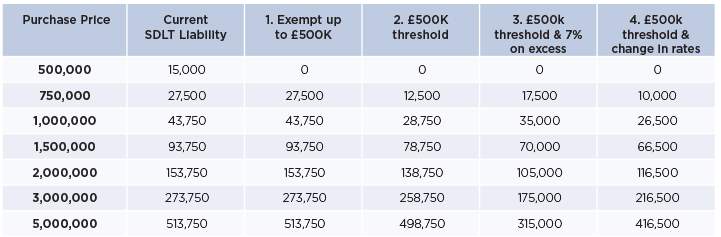
Table 1 Tax liabilities for buyers of their primary residence in four different scenarios (in £s)
Source: Savills Research
3. Lift the nil rate band threshold to £500k and pay a fixed 7% on any excess above that figures
The beauty of this is its simplicity. Compared to the previous proposal it is more advantageous to those buying at more than £1.2m and substantially so as you move up the value scale. However, it is less beneficial for those buying between £500k and £1.2m, who are more likely to be families who have traded up the ladder in London and the South East than the so called “super” wealthy. Additionally, the potential cost to the exchequer would be closer to £3.7 billion per annum, again subject to any offset from the higher transaction volumes that it encourages. That would put 38% of current stamp duty revenues “at risk”.
4. Changed rates and thresholds above £500k
Consideration could be given to retaining the current structure of progressive increases in the stamp duty rate above certain thresholds but reviewing how they operate. That essentially involves a balance between a) the political desires to free up transactions across the market b) not being seen to provide a significant giveaway to the wealthiest and c) protecting revenues without becoming unduly reliant on the very top end of the market.
Here is one example of how this might work:
- On consideration up to £500k 0%
- On consideration between £500k & £750k 4%
- On consideration between £750k & £925k 6%
- On consideration between £925k & £1.5m 8%
- On consideration over £1.5m 10%
On the basis of this example, tax losses would increase to nearly £4 billion.

Table 2 Stamp Duty Land Tax savings as a percentage of purchase price in four different scenarios
Source: Savills Research
Concluding thoughts
All the above options come at a significant cost to the Exchequer, unless there is a substantial increase in transaction levels in the top 10% of the market above £500,000 (or among investor and second home buyers paying the 3% surcharge).
Consequently, we believe that any proposals are likely to be heavily scrutinised by the Treasury in the run up to a budget, particularly given some of the spending commitments made by the new prime minister and his ministerial team.
The ability to make sweeping changes to stamp duty on residential property will also be dependent on the ability of the current government to pass a Finance Bill at a time when the majority has been cut to one (even with the support of the DUP) and there are significant divisions in parliament regarding Brexit. That position may be complicated further by the possibility of a general election before the year is out. It means that those holding out for a stamp duty cut need to carefully weigh up the likely benefit of doing so against:
- The possibility that it is delayed because of the political backdrop
- The risk that it is not as generous as they might hope (especially at the top end of the market)
- The risk that other market factors outweigh the benefit of any cut.
In that respect, it is notable that the benefits of any stamp duty cut are generally small relative to the value of properties worth more than £500,000 (see Table 2).
Taken together, this suggests it is too early for homeowners to be counting their chickens when it comes to the future of stamp duty.

Figure 3 Estimate of tax receipts forgone (assuming constant transaction levels)