
.jpg)
Online retail sales growth will fuel demand for logistics space across Europe
Logistics Market Attractiveness Index
To establish where in Europe the e-commerce revolution is likely to have the biggest shift in logistics, Savills has formed a Logistics Market Attractiveness Index. The index measures 32 European countries against 23 metrics, which assess the strengths of e-commerce and identifies the best opportunities for expanding logistics activities.
This research covers 32 European countries including Austria, Belgium, Bulgaria, Croatia, Cyprus, Czech Republic, Denmark, Estonia, Finland, France, Germany, Greece, Hungary, Ireland, Italy, Latvia, Lithuania, Luxembourg, Malta, Netherlands, Norway, Poland, Portugal, Romania, Russia, Slovakia, Slovenia, Spain, Sweden, Switzerland, Turkey, and the UK.
The analysis used to develop the Logistics Attractiveness Index draws on 23 different indicators gathered into two matrices: Ecommerce fundamentals and Logistics viability. We also added a Neighbouring countries element in our final ranking, with each country impacted by the score of its neighbouring countries, to reflect the importance of cross border online sales. The data used for the index was collected at a national level. Where possible these indicators use the latest annual data available and five-year forecasts, to ensure the index incorporates a forward-looking view.
The various indicators have been ranked and weighted across the 32 countries included in this report allowing us to develop the index. The results of the index do not determine the exclusive attractiveness of a given country to prospective logistics market players, it purely provides a macro guide for retailers and logistics market players to incorporate as part of their specific omnichannel strategy.
The final results show that Germany, France, the UK, the Netherlands and Ireland top the index, all combining strong e-commerce fundamentals, solid logistics viability and high-scoring neighbouring countries (Maps 2 and 3).
Lydia Brissy
The rise of omnichannel retail
An increase in online spending creates more demand for warehouse space. Given the rise of e-commerce and forecasted growth rates across Europe, it is, therefore, no surprise that we are experiencing unprecedented levels of demand from investors for the sector. It has to be said though that, for the most part, this is in anticipation of what is to come. Of course, we have the case studies of the UK and the US where we have seen over five years of rental growth and outperformance, even last year Industrial returns outperformed total property returns in the US by 660bps, and so the outlook is overwhelmingly positive.
However, there is a level of unpredictability as to how this growth will manifest itself across Europe. What will be the rate of growth, which sub-markets will benefit the most, which may not see any benefit? With the average yield for European Logistics coming in another 70bps through last year, a lot of this growth is being priced in already so investors need to be very confident that it will come in order to get comfortable with the entry pricing.
There will, therefore, be continued focus on urban locations, on areas with good transport links, where there is cheap and available labour and, increasingly, reliable and high levels of energy supply. At a country level, there will be a focus on high GDP growth, consumer spending habits, technological advancement. At a real estate level then, the key metric to monitor is vacancy rates. These are very low across Europe when you consider the levels of demand we anticipate from the growth of e-commerce to come. This will drive rents but we also need more development.
Rental growth in the UK in the logistics sector over the period 2008–2013 when online sales were below 10% was between 20% and 100% across the country. E-commerce picked up significantly after 2013 and last year reached 18% of total retail sales. Strong demand for logistics space over this period, especially the small-medium segment of the market, drove rental growth across the country and we now expect a similar rental growth story across the more advanced European markets.
Marcus De Minckwitz
Ecommerce Growth across Europe
Online retail accounted for 18% of total retail sales in the UK last year according to the ONS, the highest year on record, and more than any other European country. Forrester’s forecasts indicate that e-commerce will account for 25% of total retail sales in the UK by 2023 (Chart 2) although some analysts forecast that even stronger growth is on its way. In Western Europe, 10.2% of retail sales are online, whilst 5.0% is bought online in Eastern Europe.
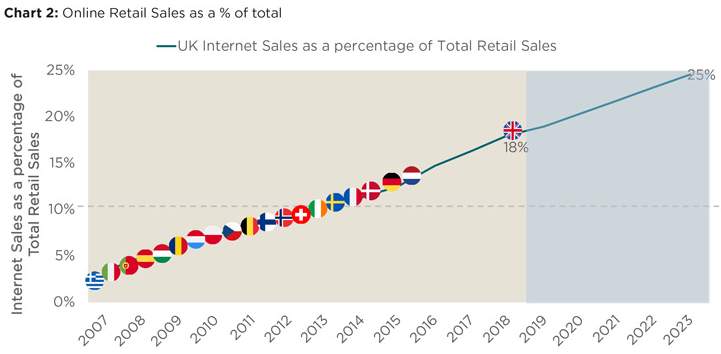
Source: Savills Research
In the UK, Savills have identified a tipping point of 10.7% of total online retail sales which creates a rapid growth in occupational demand for warehouse space. Last year, UK industrial take up related in some way to retail accounted for 53% of total demand, as the lines between physical and digital retail become increasingly blurred. We expect several countries including Netherlands, Germany and France to follow a similar trajectory in take-up volumes, as their online penetration rate hovers around this vital tipping point.
With only around 5% of total retail sales currently made online in Spain and Italy, these two markets are forecast to see the strongest online retail sales growth of all Western European markets over the next five years at 17% per annum and 21% per annum respectively. Likewise, Central and Eastern Europe will witness an average growth of 17.5% per annum, with Romania, Russia and Hungary performing the strongest.
Read the articles within European Logistics below.