

Price growth returns to prime South West London
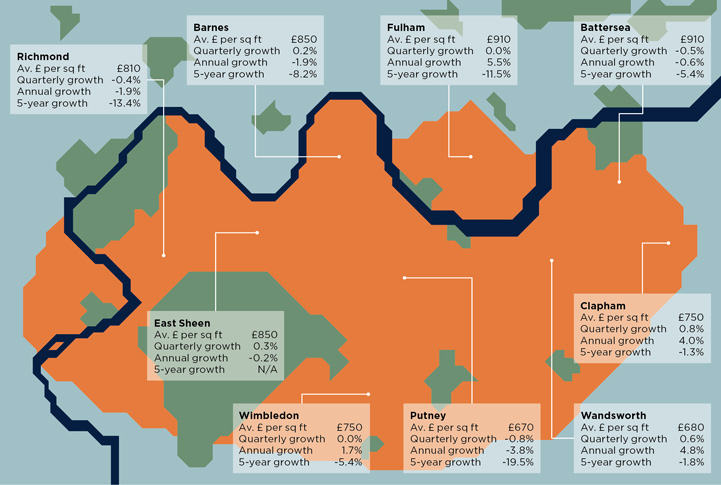
Prime property values to September 2019 (excludes new build)
Source: Savills Research
Despite the ongoing challenges faced by London’s prime residential markets in Q3 2019, price falls continued to slow as buyer and seller expectations narrowed. Brexit was cited by more than two-thirds of our agents as the main issue affecting the market. More than 90% said that buyers and sellers were concerned about the possibility of a general election.
London’s mainstream markets have been affected by similar concerns, causing average price falls of 2.6% across the wider market during the past 12 months. Yet, in the three months to September 2019, values across London’s prime housing markets fell by a marginal 0.3% on average, leaving them just 1.5% lower than the previous 12 months. By comparison, two years ago, that figure was 4.5% lower.
Values of prime housing in South West London have fallen by 7.8% on average since 2014, when new stamp duty rates were introduced
Savills Research
South West London has been the most robust of London’s prime markets during the past year, despite a fall in values of 7.8% since their previous peak in 2014, when new stamp duty rates were introduced. This has had a particular impact on the top end of the market. Prices of £2m-plus properties have fallen 11.9% since 2014 while those worth less than £1m have adjusted by just 3.5% during the same period.
But values across the region remained flat in Q3 2019 leaving them 0.9% higher than a year ago. In part, this reflects the fact that uncertainty has also led to fewer prime properties being brought to the market. At the same time we’ve seen higher levels of new applicants this year, creating a build-up of demand. Across prime South West London, for each new property that was brought to the market in Q3, there were 7.6 new applicants registered. But this remains a market that requires pragmatism from buyers and sellers alike.
Younger buyers aim for relative value
In the prime markets of Battersea, Clapham and Wandsworth, values have fallen by between 3% and 6% since the EU referendum. Falls slowed to -0.5% in Battersea and low levels of growth were recorded in Clapham and Wandsworth during Q3 2019.
The majority (67%) of buyers in these areas are aged under 40 and are often supported by the Bank of Mum and Dad. Younger buyers are taking advantage of the relative value on offer in these markets, when compared with other parts of prime London, which continues to be a strong driver of demand.
By comparison, in prime markets such as Barnes, Putney and Richmond, 70% of buyers have children. Values in these family-orientated markets have fallen by as much as 17% since the EU referendum, as uncertainty around the economic impact of Brexit has made buyers much more cost-conscious. Such falls have increasingly left larger family homes looking good value in a historic context.
In Fulham, price falls have totalled 6.4% since the Brexit vote, but have increased by 5.5% in the past year, in part due to low levels of new stock being brought to the market.
Here, the majority of buyers (57%) are moving from within the borough of Hammersmith and Fulham, a factor which highlights the area’s staying power.
Outlook
We expect the sense of caution in the market to continue for the rest of the year, as buyers wait to see whether the current government will be able to negotiate a deal with the EU before the end of October, or forced by parliament to seek a further extension of Article 50. The prospect of a general election by the end of the year is likely to add to this. However, given the extent to which prices have already corrected, we do not envisage significant price adjustments during this period.
Current polling shows that the election of a hard left majority government would require a substantial swing in voting intentions. This limits the risk of a dramatic change in the political environment which might significantly alter the attractiveness of London to ultra-high-net-worth individuals. But only once this risk has passed entirely do we expect the seeds of recovery to be planted.
We also believe that cuts to stamp duty that were mooted by Boris Johnson in his leadership bid cannot be relied upon. First, it’s uncertain whether the Conservatives can deliver a clear majority. Also, any government is going to be reluctant to put at risk receipts which we estimate to be between £2 billion and £4 billion, at a time when it will be looking to increase spending to support the economy.
Deal or no deal, what is needed to stimulate market demand is greater certainty over the way forward. In South West London, young buyers taking advantage of the relative value on offer continue to keep the market moving, as do growing families and, in particular, those in search of good schools and green space.
We anticipate this will continue in the short term.
Interested in other areas of the UK?
View all of our latest prime Market in Minutes research here.