.jpg)
With conventional agriculture on marginal land looking increasingly vulnerable due to the removal of Basic Payment Scheme support, some land occupiers are considering whether rewilding is an option
Rewilding is at one end of a land-use intensity spectrum, where the large-scale restoration of landscapes through natural processes and species take centre stage and agricultural practices take a back seat. Before considering rewilding as a land management strategy, here are some key points to think about:
- Purpose
Personal motivations and financial objectives are the crucial first step, because there is no standard definition of ‘rewilding’. Agreeing how success will be evaluated and determining the management approach must be carefully planned.
- Profit
Understanding the profitability of current land use is crucial. For let land, this is straightforward; for in-hand farming, profitability may be more volatile. The key metric in evaluating the long term success of rewilding will always be profit per acre, not yield.
- Livestock
The unwritten principle of rewilding is the role livestock play in grazing and restoring plant diversity. The extremely low stocking densities (< 0.3LU per hectare) and free roaming of the animals allow landscapes to recover naturally. The lack of natural predators means human control of grazing herbivores remains the key route through which rewilding is achieved.
- Fence
If there is no pre-existing livestock enterprise, investment in fencing will be crucial to manage highly extensive grazing. A ring-fenced estate is not the only option though. Landscape-scale benefits are possible if several landowners collaborate to adopt extensive management for the benefit of a broader area.
- Transition
The transition from intensive to highly extensive management of land produces the ecological bonus that is rewarded through an agri-environmental programme or tourism enterprise. A settled form of highly extensive management will be needed long term, and it may be difficult to revert the land back to conventional production.
- Star species
Rewilding enterprises tend to rely on consumer engagement and often that is in the form of safaris or wildlife experiences. It may, however, take several years for habitats to form to support the ‘star species’ that attract visitors, such as rare butterflies or migratory birds. Native species such as beavers may be an option instead.
- People
People, profit and environment can be uneasy bedfellows. Given that there is no standard process for rewilding, it is up to each scheme manager to determine the right balance between welcoming visitors, engaging neighbours and communities and providing habitat for rare and vulnerable species.
- Inheritance tax and land values
Land ownership is constrained by the rules of IHT. Proof of active farming is important for both Basic Payment Scheme and Agricultural Property Relief, so take advice to ensure that asset values are not negatively impacted by the pursuit of conservation objectives.
- Finances
To be financially viable, there may need to be an investment phase or the phased adoption of rewilding. Rewilding is a diversification option that can support enterprises such as safaris, glamping and weddings, as well as meat boxes.

Somerleyton Estate: a venture into the wild
An innovative rewilding project in Suffolk
Lord Somerleyton is leading an ambitious rewilding project across his 5,000-acre estate in Suffolk, requiring a ‘complete mindset shift’ from a conventional arable set-up to a new type of landscape management that values conservation and regenerative farming.
Currently, three areas of the estate are being rewilded, through arable reversion and tree felling, with the vision of creating what Lord Somerleyton calls ‘wildland’ – over 1,000 acres of open grazing.
The estate has introduced Welsh Black cattle (who roam with two years of followers, on a natural weaning system), Large Black sows, Norfolk Horn sheep, Exmoor ponies and red and fallow deer to graze across the reserves.
After securing a bid for a Natural England fencing scheme, the main reserve will have a six and a half mile ring-fence, keeping stock in but enabling deer to come and go. Eventually, the aim is to introduce European bison or water buffalo.
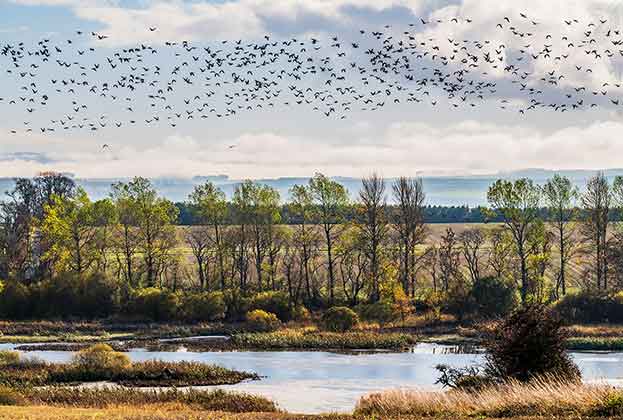
Elsewhere, the estate is recreating a mosaic of marshy land with a variety of swards, to encourage species such as lapwing and redshank.
Lord Somerleyton’s advice for those thinking about embarking on rewilding projects is to ‘rip up the rules’ and dare to be experimental
Savills Rural Research
In how to define what a ‘natural’ rewilded landscape constitutes, Lord Somerleyton explained he ‘went backwards to go forwards’, taking inspiration from historical photographs and estate maps in order to devise a naturalistic management plan.
It is clear that this is not simply about letting nature dominate: Lord Somerleyton believes rewilding is about vision-led management, which includes humans – ‘educating, inspiring, shaming and committing’ people into restoring wildlife. In his eyes, cooperation is key to success.
Lord Somerleyton is the first to stress that his passion for nature has been crucial in driving the rewilding project across his estate. However, that doesn’t mean the enterprise isn’t profitable – income streams include the estate’s tourism enterprise, their beef sales and timber.
His advice for those thinking about embarking on rewilding projects is to ‘rip up the rules’ and dare to be experimental.

NATURAL CAPITAL SOLUTIONS: PEAT
Globally, peatlands store more carbon than the world’s rainforests. Peatland sequesters 370 million tonnes of carbon dioxide a year, which is enough to offset the emissions of nearly 80 million passenger vehicles and is equivalent to 176 million hectares of forest.
Peatland landscapes include fens, bogs and swamps, all of which remain waterlogged throughout the year. This slows plant decomposition, enabling dead plant material to accumulate, which is why peatland can store such vast quantities of carbon. Unlike woodland, which becomes saturated once it matures, peatland continues drawing down carbon over millennia as layers of peat accumulate.
Not only do peatlands store carbon, but they also provide essential ecosystem services. Healthy peatlands improve water quality (the UK and Republic of Ireland account for 85% of global consumption of peat-sourced water), reduce flooding impacts, conserve biodiversity and provide a space for recreation.
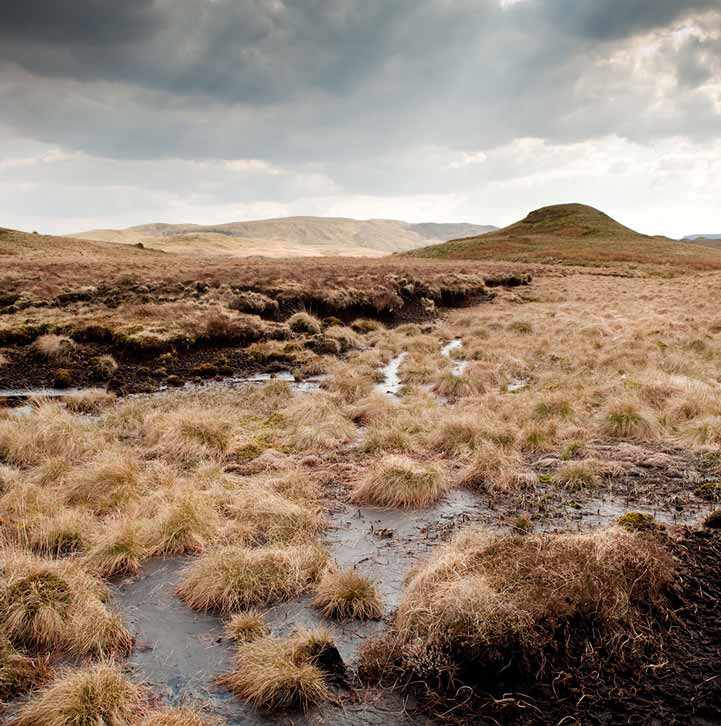
In total, peat bogs cover around 10% of Britain’s land area, with half of that being in Scotland. These peatlands represent the single most important terrestrial carbon store in the UK and yet 80% have been damaged by drainage, extraction, burning and overgrazing.
This degradation releases CO2. It is estimated that damaged UK peatlands are releasing 3.7 million tonnes of CO2 each year, equal to the emissions of 660,000 UK households.
Fortunately, peatland can recover through rewetting and catchment reconnection, recreating a carbon sink. According to the International Union for Conservation of Nature, there are currently 92 projects of peatland restoration in the UK.
This does not have to mean an end to productivity if the land was formerly agricultural. Paludiculture is the cultivation of wet peatlands for agricultural production while maintaining the ecosystem services that they provide.
Despite peatland restoration being a cross-party policy aim, current public funding is limited. As with tree planting, an alternative source of funding is through voluntary carbon market buyers.
The Peatland Code provides assurance to buyers that the climate benefits of peatland being sold are real, quantifiable and permanent. It is likely that peatland restoration will be included as a public good in future agricultural policy schemes.
Rewilding Britain proposes paying £584–£876 per hectare per year for rewilding peat bogs, however, private markets may increase potential income.
Read the articles within Spotlight: Natural Capital below.