.jpg)
Across the prime rental market, there have been significant levels of growth over the past three years. But, higher inflation and the cost of living have taken some of the heat out of the market. We look at four areas, how they have performed and the trends driving their individual markets
Savills prime London region stretches from central locations in Mayfair and Kensington, to Hampstead in the North, Richmond in the South West, Ealing in the West and Canary Wharf in the East.
Across the capital, tenant demand has remained strong compared to previous years. But the number of prospective renters registering with Savills in March was broadly on par with March last year and -10% below the same month in 2021.
As a result, average prime rents increased by 1.4% during the first three months of 2023, a significant slowdown from the 3.5% in Q1 2022. Annual growth eased across all London regions, totalling 8.7% on average. Again, notably below the 13.8% peak in Q3 2022, when the balance between supply and demand was at its worst.
Smaller, lower-value properties have performed the strongest over the start of 2023. In this part of the market, needs-based, domestic tenants, including young professionals and families, have continued to drive competition for a limited supply of properties. However, at these price points, some tenants' budgets are under pressure from higher inflation and the cost of living, which will limit capacity for further growth.
At the top end of London’s rental market, demand is typically more discretionary and rental growth has eased. But across specific locations, a lack of suitable prime houses means there is still some upward pressure on rents.

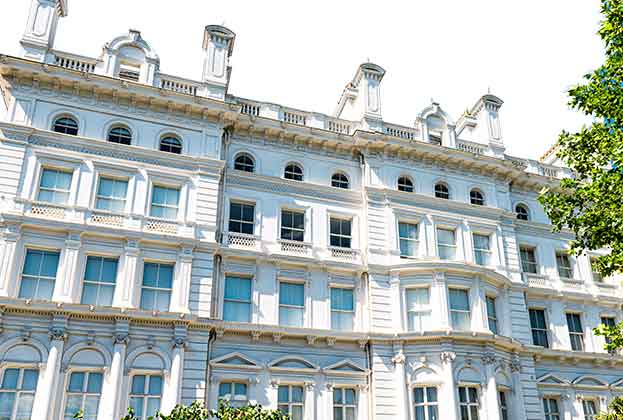
Kensington, London | Credit: Miroslav
The prime commuter belt ranges from Elmbridge in London’s suburbs, to Guildford and Tunbridge Wells up to a 30-minute commute to London, within the inner commute. In the outer commute, up to an hour from London, locations include Winchester and Henley.
Here, rents are up by an average of 1.1% during the first quarter, lower than the 2.1% recorded at the same point last year. Annual growth averaged at 4.8%, suggesting it is levelling out following three years of rental increases which now total 18.7%.
Across the commuter belt the number of new applicants registering has continued to rise in March, with levels higher than the same month over the past five years. Despite demand remaining strong, tenants have become more aware of pricing, as budgets have been squeezed by wider financial pressures. Therefore, realistic asking rents will be key to maintaining interest moving forward.
Regional towns and cities cover urban locations across the UK, from Edinburgh in Scotland, Manchester in the North and Reading and Cambridge closer to the capital. These markets are typically characterised by a higher proportion of city centre locations and strong demand from young professionals and corporate relocators.
Across these markets, average rents increased by 0.4% over the first three months of 2023. This is the slowest rate of quarterly growth since Q2 2020 and a significant slowdown from the peak of 3.5% during the second quarter of 2022. Over the past 12 months, rents are up 7.6% and are 17.6% higher than March 2020.
But, there has been some variation. Northern cities experienced rental falls over the start of this year as tenants have become more aware of changes in the market. However, locations closer to London including Cambridge and Reading, still saw rents rise, as demand remained strong and supply continued to be limited, especially across lower price bands.
Elsewhere, Edinburgh faces a unique set of drivers. Current legislation imposes temporary rent caps and restricts evictions but only for existing tenancies. While changes to the Scottish Additional Dwelling Supplement at the end of last year could limit supply levels moving forward.
.jpg)
Edinburgh | Credit: Oliver
This region covers the Cotswolds Area of Outstanding Natural Beauty but also the surrounding towns and cities of Oxford, Cheltenham and Bristol and includes a range of prime properties from smaller urban flats to large detached farmhouses.
On average, prime rents are up 0.7% during Q1 this year, with annual growth totalling 1.9%, after four consecutive quarters of subdued growth. However, rents are up 19.9% over the three years since March 2020, driven by the flight to country locations over much of 2020 and 2021.
Despite a strong performance over previous years, there has been a recent shift in market dynamics. As tenants have become more considered on pricing, the gap between tenant and landlord expectations has widened. Moving forward, those landlords who choose to price sensibly will attract the most interest.

Broadway, Cotswolds | Credit: arenaphotouk
Outlook:
What we think 2023 and beyond holds for the prime rental markets
In the short term, we expect the imbalance between supply and demand to continue to drive rental growth. But, with higher levels of inflation and increased cost of living, we anticipate the rate of rental growth will slow over the rest of this year and into 2024. Significant growth over the past three years also limits the capacity for further substantial growth. As a result, sensible pricing will be key to attracting tenants and securing tenancies moving forward.
Stock shortages are also likely to ease gradually as additional supply comes to the market from cash investors looking to take advantage of higher rents as well as accidental landlords, as the sales market cools. We are therefore forecasting rates of rental growth will return to more historic norms over the longer term.
To read more of our Residential Research please visit our Residential Hub
Read the articles within Report: Prime UK Residential – spring/summer 2023 below